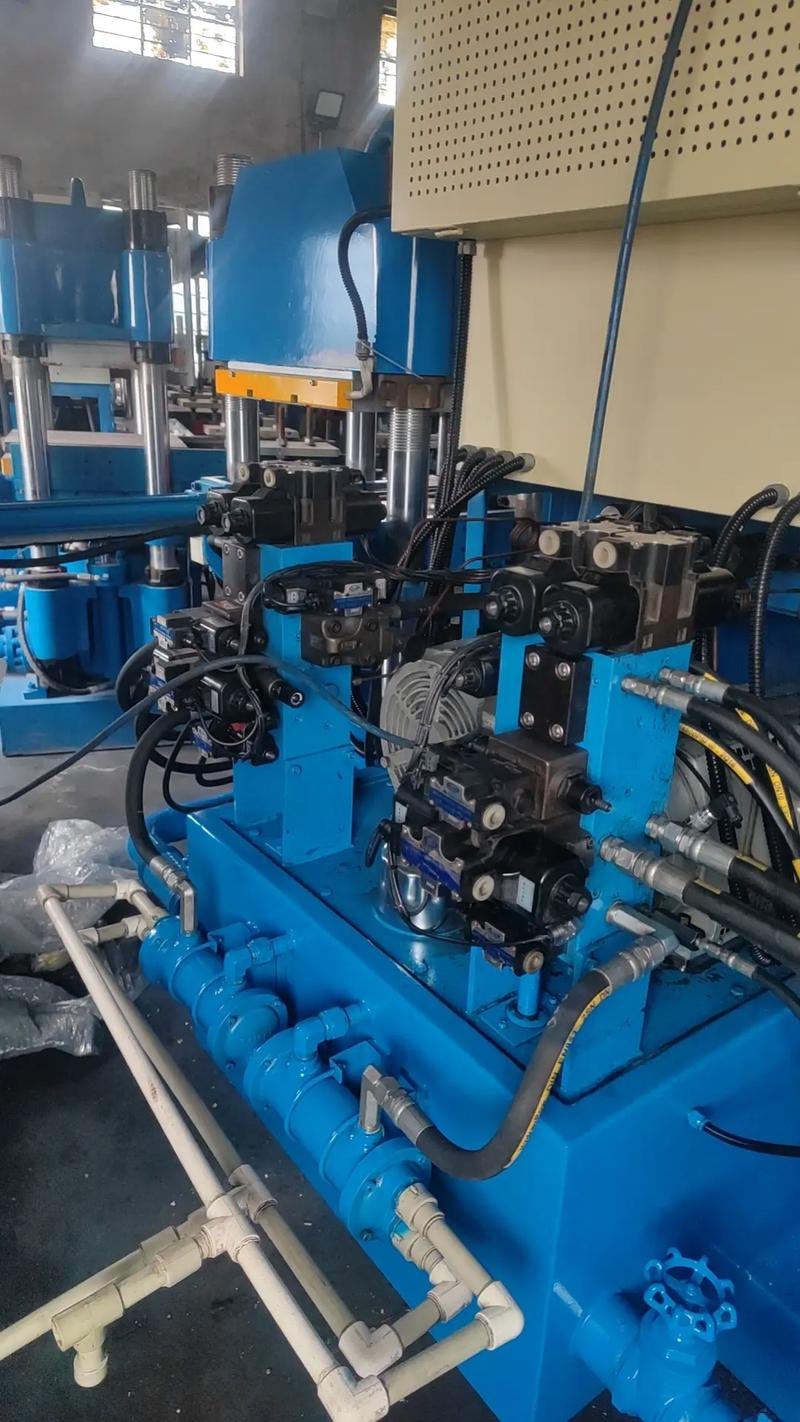
Semi-automatic Rubber Frame Vulcanizing Machine Of 500-ton Clamping Force
Related to rubber anti-slip mats and shock-absorbing mat manufacturing machines.
Overview of the Machine
This machine is a type of hydraulic press specifically designed for the compression molding and vulcanization of rubber products. The "semi-automatic" and "frame" aspects are key to its design and operation.
- 500-ton Clamping Force: This is the core power of the machine. It refers to the immense pressure (500 US tons or ~450 metric tons) that the press can exert to compress the raw rubber material inside the mold. This pressure is crucial for:
- Filling the mold cavity completely to achieve the precise shape and pattern (e.g., the anti-slip nubs)
- Forcing out trapped air to prevent voids and defects
- Ensuring efficient heat transfer for vulcanization
- Frame Structure: Unlike a C-frame press, a "frame" or "four-column" press has a robust, box-like structure with four guiding columns. This provides exceptional stability and parallelism between the platens, which is essential for producing mats with consistent thickness and uniform density.
- Semi-automatic Operation: This means the machine automates the most critical and repetitive parts of the cycle (clamping, heating, pressure application, timing) but requires an operator for the loading and unloading steps.
- Operator does: Place the raw rubber charge (often a pre-cut slab or calendered sheet) into the mold and remove the finished mat after the cycle
- Machine does automatically: Close the press, apply the full clamping force, heat the mold to the set temperature, hold for the precise cure time, then open
- Vulcanizing: This is the chemical process that transforms soft, plastic, raw rubber into a strong, elastic, and durable material. The machine's heated platens (the large, flat, heated surfaces that sandwich the mold) provide the necessary heat (typically between 140°C - 180°C / 284°F - 356°F) to activate the sulfur or other curatives in the rubber compound.
Its Specific Role in Anti-Slip & Shock-Absorbing Mat Manufacturing
This machine is not just related to this industry; it is often the central piece of equipment in a production line for high-quality mats.
1. For Rubber Anti-Slip Mats:
- Precision Molding: It perfectly forms the intricate patterns--nubs, diamonds, ridges, or custom logos--that create the anti-slip surface. The high pressure ensures every detail of the mold is replicated.
- Material Consistency: By applying uniform heat and pressure across the entire mold, it ensures the mat has a consistent density and hardness, which is critical for its performance and longevity.
- Durability: The vulcanization process cross-links the polymer chains, making the mat resistant to wear, weather, oils, and chemicals, which is essential for industrial, commercial, or outdoor use.
2. For Rubber Shock-Absorbing Mats:
- Controlled Density & Cushioning: The pressure and heat control during vulcanization directly determine the final density and elastic properties of the rubber. This allows manufacturers to produce mats with specific shock-absorption (damping) characteristics, crucial for gym floors, playground surfaces, or industrial standing mats.
- Ability for Multi-Layer Mats: Some shock-absorbing mats are made from different layers of rubber (e.g., a dense base and a softer top). This press can be used to co-vulcanize these layers into a single, integral unit.
- Flatness and Stability: The frame structure ensures the finished mat is flat and has a consistent thickness, preventing tripping hazards and ensuring proper performance.
Typical Technical Specifications
A machine of this type would generally have specifications like:
| Feature |
Typical Specification |
| Clamping Force |
500 Tons |
| Daylight |
600 - 1000 mm (space between platens when open) |
| Platen Size |
e.g., 1200 x 1200 mm or 1500 x 1000 mm (designed to fit standard mold sizes for mats) |
| Platen Temperature |
Up to 200°C, electrically heated with cartridge heaters or via steam |
| Control System |
PLC (Programmable Logic Controller) with Touch Screen HMI. Allows for storing multiple recipes for different mat types |
| Safety |
Two-hand operation, light curtains, and mechanical guards |
Comparison in the Manufacturing Context
To understand why this machine is chosen, it's helpful to compare it to other methods:
| Method |
Pros |
Cons |
Best For |
| Semi-Auto 500-ton Frame Press |
High quality, excellent consistency, high durability, suitable for complex patterns and thick mats |
Higher initial cost, slower cycle time than extrusion, requires mold investment |
Premium anti-slip mats, heavy-duty shock-absorbing mats, mats with complex designs |
| Extrusion & Post-Cure |
Very high production speed, continuous length |
Limited to uniform cross-sections, patterns are usually rolled on, not molded in. Can have lower density |
Lower-cost, simple pattern mats in very high volume |
| Injection Molding |
Fast cycle times, high automation |
Very high machine and mold cost, size limitations |
Small, complex rubber parts, not typically large mats |
| Manual Presses |
Lower cost, flexibility |
Inconsistent quality, reliant on operator skill, lower safety |
Small workshops, prototyping |
Conclusion
The Semi-automatic Rubber Frame Vulcanizing Machine with a 500-ton Clamping Force is a workhorse for manufacturers producing high-performance, durable rubber mats. It perfectly balances the need for automated precision and control in the vulcanization process with the flexibility for an operator to handle larger, sheet-like products. For anyone in the business of making reliable anti-slip or shock-absorbing mats, this machine represents a critical investment in quality and capability.